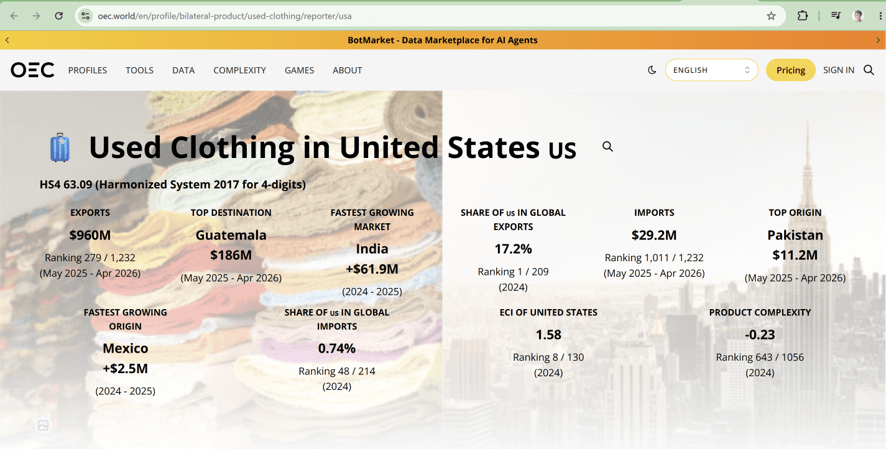
Taken from the website: https://oec.world/en/profile/bilateral-product/used-clothing/reporter/usa
This page from the Observatory of Economic Complexity (OEC) shows the trade flows of second-hand clothing (HS 6309) relating to the United States, providing an insight into how the global second-hand clothing market works. It is an excellent resource for understanding the economic scale of this sector.
Let’s analyse each indicator.
1. What does ‘Used Clothing in the United States’ mean?
This profile refers to the customs code:
HS 6309 – Worn Clothing and Other Worn Articles
In other words:
- second-hand clothing;
- second-hand footwear;
- second-hand textiles intended for reuse.
It does not include textile waste for industrial recycling. It refers to clothing sold for reuse.
2. Exports – 960 million dollars
This is probably the most important figure.
Exports: $960M
This means that, between May 2025 and April 2026, the United States exported around $960 million worth of second-hand clothing.
This amounts to almost $1 billion in a single year.
It is a huge market.
3. US Share of Global Exports – 17.2%
This figure is even more impressive.
The US accounts for:
17.2% of global exports of second-hand clothing.
In other words,
almost one in every five items of second-hand clothing exported worldwide comes from the United States.
This is why the US is frequently linked to the ‘mitumba’ trade.
4. Top Destination – Guatemala
The main buyer of American second-hand clothing is:
Guatemala
Value:
186 million dollars
Much of this clothing:
- is consumed locally;
- is re-exported;
- is sorted again.
Not all of it goes directly to Africa.
There is a vast international redistribution network.
5. Fastest Growing Market – India
This indicator refers to:
the country that has seen the greatest increase in purchases of second-hand American clothing.
It was:
India
Increase:
+US$61.9 million
This may be due to:
- textile recycling;
- industrial reuse;
- sorting;
- resale.
India is one of the world’s largest centres for textile recycling.
6. Imports – 29.2 million
Although the US exports a great deal,
it also imports second-hand clothing.
Value:
29.2 million.
In other words,
it also receives second-hand clothing from other countries.
7. Top Origin – Pakistan
The US’s main supplier is:
Pakistan
11.2 million.
Why?
Because Pakistan:
- sorts;
- refurbishes;
- exports second-hand clothing;
- has a large textile industry.
8. Fastest Growing Origin – Mexico
Mexico was the country that saw the greatest increase in exports of second-hand clothing to the US.
9. ECI of the United States – 1.58
ECI stands for:
Economic Complexity Index
It is an indicator created by Harvard that measures a country’s economic sophistication.
The higher the figure:
- the greater the industrial know-how;
- the greater the technological capacity;
- the greater the diversity of production.
The US ranks:
8th in the world
10. Product Complexity – -0.23
This indicator measures the complexity of the product.
Second-hand clothing has a score of:
-0.23
Because it is a very simple product.
It does not require:
- high technology;
- engineering;
- complex manufacturing.
It is a product with low added value.
What does this page tell us about the global market?
We can visualise the journey of the clothing as a chain:
American consumers
↓
Donations
↓
Sorting companies
↓
Export
↓
Guatemala
India
Africa
Latin America
↓
Further sorting
↓
Mitumba markets
↓
End consumer
↓
Textile waste
Where does Ghana fit into this?
Although this page shows Guatemala as the main destination for US exports, this does not mean that Ghana is no longer one of the world’s largest markets for mitumba.
This is because:
- Ghana imports clothes from many countries (the UK, Germany, the Netherlands, Canada, China, amongst others);
- some of the clothes exported by the US may reach Ghana indirectly, passing first through sorting or redistribution centres in other countries;
- the OEC page shows only direct trade flows from the US.
Why is this information so important to the IAW?
This page helps to demonstrate that the issue is not only environmental, but also economic and logistical. The international trade in second-hand clothing is worth hundreds of millions of dollars and involves a global chain of collection, sorting, transport and resale.
For the IAW, this type of data makes it possible to clearly explain the difference between two realities:
- Second-hand clothing (mitumba) remains an economic resource as long as it can be reused and sold.
- Textile waste arises when a portion of this clothing no longer has any commercial value. It is this fraction that often ends up in landfill sites, on beaches, in rivers or is burnt.
It is precisely at this final stage that IAW intervenes, transforming textile waste into raw material (SOMA) for new products, preventing materials with no commercial value from becoming an environmental problem and extending their life cycle within a circular economy framework.


